
Parallel Play: A Daycare Provider's Guide (2026)
MyKidReports' daycare software runs billing, attendance, daily reports and parent messaging for every size of program, free for up to five children.
Parallel Play: The Complete Daycare Provider's Guide (2026)
15 activities, age ranges, classroom setup, and how to spot it in your room — written for directors and teachers.
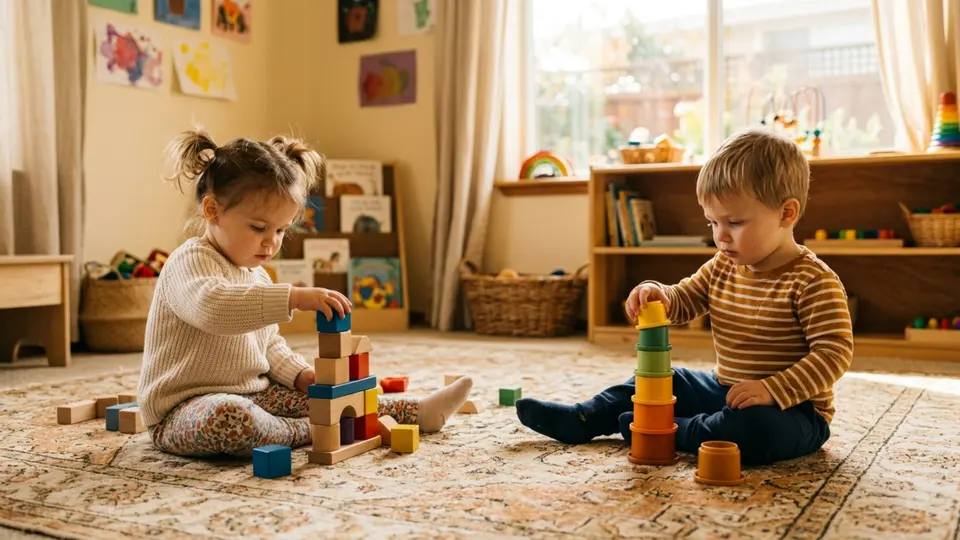
It's Tuesday morning in the two-year-old room. Mia and Jacob are sitting eighteen inches apart on the rug. Mia is stacking wooden blocks into a tower. Jacob is stacking cups into a tower. Neither child is talking to the other. Neither child is sharing. They occasionally glance over. Then back to their own tower.
A first-year teacher walks in and assumes something is wrong. "Why aren't they playing together?"
A fifteen-year director walks in and smiles. "That's exactly what they should be doing."
That's parallel play. It's one of the most important — and most misunderstood — stages of early childhood social development. This guide walks you through what it is, the developmental science behind it, fifteen activities you can run in your room tomorrow, how to set up your environment to encourage it, and how to know when a child is ready to move on to the next stage.
Key takeaways
- Parallel play is when toddlers play side-by-side without directly interacting — and it's a critical developmental milestone, not a problem.
- Typical age range: 2 to 3 years old, with the stage often extending to age 4.
- Position in development: Stage 4 of Mildred Parten's six stages of play (1932), still the foundational framework used by NAEYC, the CDC, and early childhood programs worldwide.
- Why it matters: Parallel play is how toddlers learn observational social skills, language by exposure, and the first awareness of peers — all without the cognitive load of cooperation.
- For directors: Tracking play stages across your roster is one of the clearest indicators of healthy social development. Soft-flag any 3-year-old still stuck in solitary play.
What Is Parallel Play? A Definition for Childcare Providers
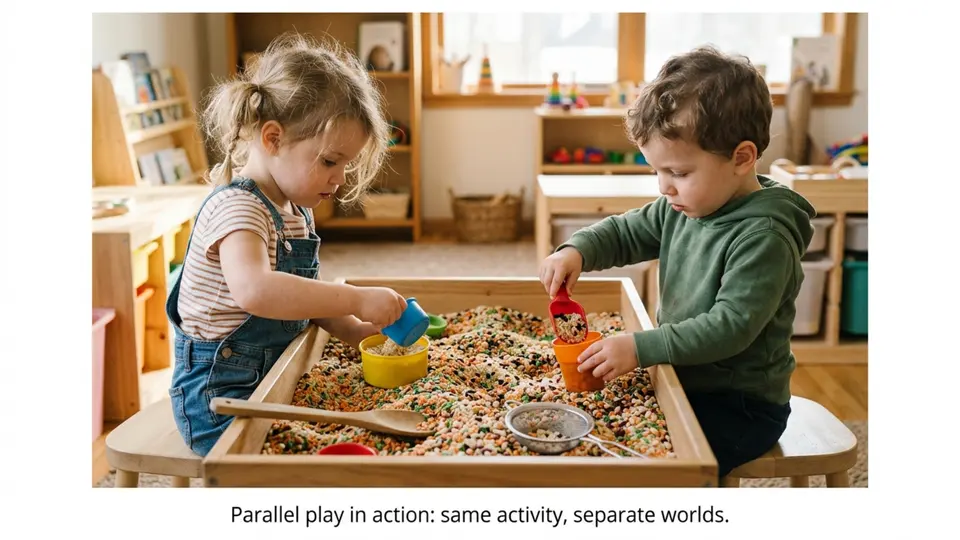
Parallel play is the stage of social play where two or more children play in close proximity to each other — often using the same kind of materials — but without directly engaging, sharing, or organizing the activity together.
The defining features:
- Side-by-side proximity: Children play near each other, often within arm's reach.
- Similar activities: Same toys, same materials, similar actions — but each child is doing their own version.
- No verbal coordination: They don't ask each other for things, narrate to each other, or agree on rules.
- Awareness without engagement: They notice each other. They may copy each other. But they don't yet play together.
It's not antisocial behavior. It's not a sign your toddler is "behind." It's a specific developmental stage that, according to NAEYC's Principles of Child Development and Learning, is exactly what should happen in the second and third years of life.
Mildred Parten's Six Stages of Play (Why This Framework Still Matters)
In 1932, a graduate student at the University of Minnesota named Mildred Parten Newhall published research that has shaped early childhood education ever since. She observed children ages 2–5 in free play and identified six progressive stages of social play. Nearly a century later, her framework is still cited by the National Library of Medicine's research on peer play, and developmentally appropriate practice (DAP) programs still use it as the lens for understanding how toddlers grow into cooperative players.
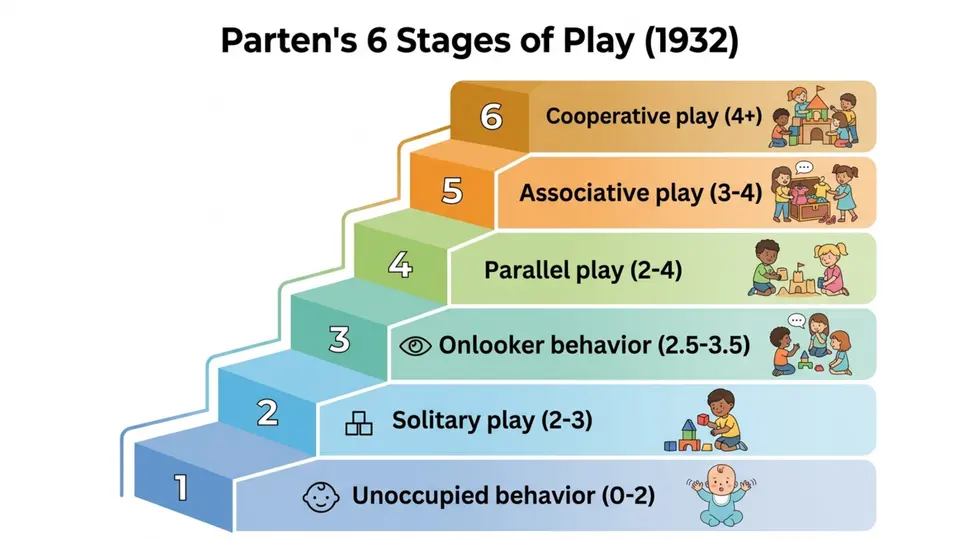
Here are the six stages and what each looks like in your room:
Stage 1 — Unoccupied behavior (birth to ~2)
The child isn't engaged in active play. They might be watching something in the room, idling, or making small movements. To a teacher this might look like "doing nothing" — but the child is taking in their environment.
Stage 2 — Solitary independent play (ages 2–3)
The child plays alone, focused on their own activity, even when other children are nearby. They may not notice or care that other children exist in the moment. Common in younger toddlers.
Stage 3 — Onlooker behavior (ages 2.5–3.5)
The child watches other children play. They might stand at the edge of an activity, observing closely, possibly even commenting — but they don't join in. This is preparation, not avoidance.
Stage 4 — Parallel play (ages 2–4, peaks 2–3) ← This is what we're covering today
Children play side-by-side, using similar materials, often imitating each other. No coordinated interaction. This is the stage where toddlers start building the bridge from "I" to "we."
Stage 5 — Associative play (ages 3–4)
Children now interact with each other while playing — chatting, sharing materials, swapping toys — but they're still doing their own thing. There's conversation around the activity, but no shared goal yet.
Stage 6 — Cooperative play (ages 4+)
The full social game. Children agree on rules, share roles, and work toward a common goal — pretending to run a restaurant together, building a tower as a team, organizing a game with turns.
Each stage builds on the one before. Skipping or rushing stages doesn't work — children need time in parallel play to develop the observational skills that make associative and cooperative play possible.
When Does Parallel Play Begin? And When Does It Fade?
According to the CDC's Developmental Milestones and the pediatric play-development literature, here's the typical timeline:
Age | What you'll usually see |
12–18 months | Mostly solitary play, with occasional onlooker behavior. Toddler may bring a toy to an adult but rarely to a peer. |
18–24 months | First signs of parallel play. Toddler plays near another child with similar toys but doesn't yet imitate or engage. |
2 years | Parallel play emerges in full. Toddlers seek out other children to play near, often choose the same kind of materials, and may briefly imitate each other. |
2.5–3 years | Peak parallel play. This is the dominant social play behavior of this age. |
3–4 years | Parallel play starts shifting toward associative play. Children begin talking to each other during play and occasionally trading toys. |
4+ years | Cooperative play takes over as the primary mode, though parallel play still happens — even adults do it (think two people reading next to each other on a couch). |
The shift from parallel to cooperative play isn't a hard switch. Most 3-year-olds bounce between parallel, associative, and brief moments of cooperative play within a single 20-minute free-play session.
15 Parallel Play Activities for Your Toddler Room
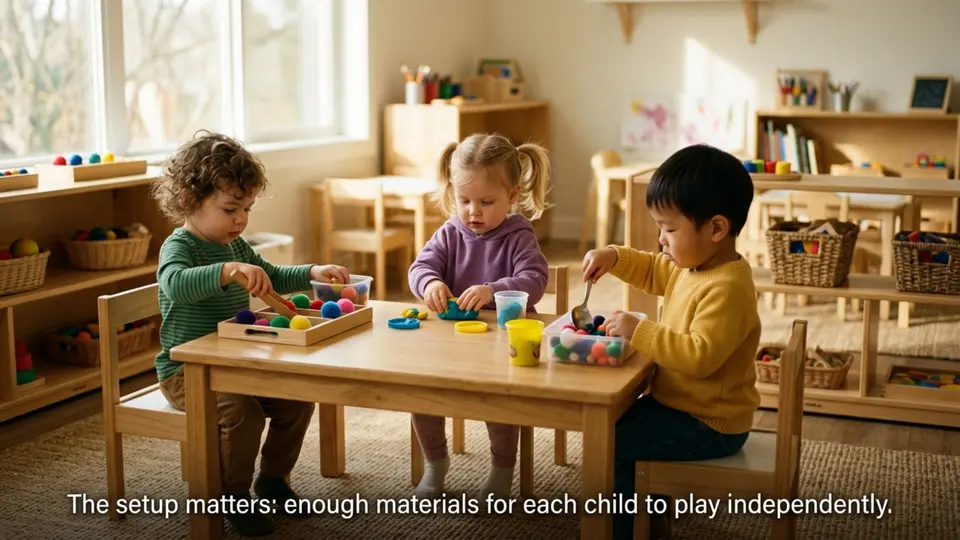
These are activities your teachers can set up in 10 minutes or less, using materials most centers already have. Each activity is designed to encourage parallel play — meaning each child has enough of the material to play independently while still being side-by-side with peers.
- Sensory bins, one per child. Set up small sensory bins (one for each child) filled with the same material — rice, dried beans, water beads, kinetic sand. Each child gets their own scoop and cup. They'll explore independently while watching each other's techniques.
- Side-by-side play dough. Give each child their own ball of play dough and the same tool set (rolling pin, cookie cutters, plastic knife). They'll naturally invent their own creations while occasionally copying each other.
- Parallel block building. Set out two or three identical sets of wooden blocks on a rug. Don't give a project or theme — let each child build whatever they want. Most toddlers will build towers side-by-side.
- Mirror painting. Give each child their own paper and the same set of brushes and washable paints. They'll often start mirroring each other's strokes within minutes.
- Stacking cups race (without the race). Hand each child a set of stacking cups. No competition, no instruction — just "see what you can do." They'll stack, knock down, restack, and observe each other's strategies.
- Water play with multiple stations. Set up two small water tubs with identical pouring tools (cups, funnels, sponges). Two children, two stations, side-by-side. Add a few drops of food coloring for variety.
- Toddler yoga together. Lay out individual mats in a line. Lead a simple toddler yoga sequence — child's pose, downward dog, butterfly. Children will try to follow along, watching each other while doing their own version.
- Magnatile castles. Spread out magnetic tiles on a low table. Each child grabs a handful and builds their own thing. The shared material with individual creations is parallel play in its purest form.
- Stickers and paper. A pile of stickers in the middle, individual sheets of construction paper for each child. They'll peel and stick on their own page while glancing at what others are doing.
- Mini garden planting. Set up small individual pots for each child with soil and a single seedling. Each child plants their own. Side-by-side, similar task, no need to share. Bonus: a long-running project they can return to daily.
- Side-by-side easels. If you have two easels, set them up next to each other with identical paper and paints. Two toddlers, two easels, side-by-side painting.
- Puzzle stations. Set out two or three of the same simple puzzle on a low table. Each child works their own puzzle but observes how others approach theirs.
- Sandbox digging. Outdoor sandbox with multiple sets of identical scoops, shovels, and buckets. Each child digs their own hole, builds their own pile.
- Cardboard box city. Give each child a small cardboard box and a basket of markers, stickers, and washi tape. They'll each decorate their own "box building." When they're done, line them up on the floor — instant city.
- Side-by-side reading. Yes — reading is play. Put a basket of board books in the cozy corner with multiple copies of the same favorites. Two toddlers can sit next to each other, each "reading" their own book.
How to Set Up Your Environment for Parallel Play
The activity matters less than the environment. Three rules of thumb for your classroom layout:
Rule 1 — One of everything, two of most things
For parallel play, each child needs their own materials. If you have only one set of stacking cups, you'll force sharing — which is great for cooperative play, but pushes toddlers above their developmental level. For toddler rooms, aim for at least 2–3 of every popular toy, sized for the age group.
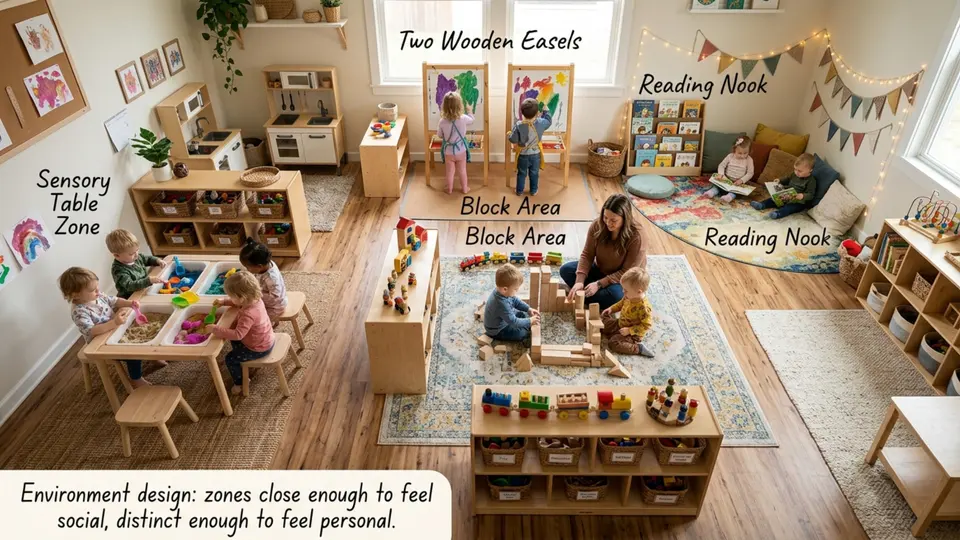
Rule 2 — Set up "play zones" close enough to feel social, distinct enough to feel like their own space
Low tables, individual mats, separate baskets of materials within a defined zone — these signal to a toddler "this is yours, but you're not alone." A rug with three play mats arranged in a horseshoe is better than a giant open area or completely isolated stations.
Rule 3 — Don't intervene unless safety is at stake
The biggest mistake new teachers make in parallel play is trying to make children play together. "Look, Jacob, Mia is also stacking — why don't you build together?" This pushes the child past their developmental stage and often results in conflict.
Trust the process. Toddlers will move toward associative play on their own timeline. Your job during parallel play is to be a quiet, present, available adult — not a play director.
Parallel Play vs. Cooperative Play: Key Differences
Teachers — especially new ones — often confuse parallel and cooperative play. Here's a side-by-side breakdown:
| Parallel play | Cooperative play |
Typical age | 2–3 years | 4+ years |
Interaction | None or minimal | Active back-and-forth |
Materials | Each child has their own | Shared among the group |
Communication | Silent or self-talk | Verbal, planning, negotiating |
Goal | Individual exploration | Shared objective |
Structure | No rules, no roles | Defined roles, often rules |
Adult role | Set up environment, observe | Coach, mediate, facilitate |
What you'll hear | Quiet focus, occasional sound effects | "You be the mom, I'll be the baby" |
A 3-year-old will often bounce between parallel and associative play. A 4-year-old might still default to parallel play when introduced to new peers or a new environment. Both are normal.
When to Be Concerned: Red Flags for Directors
Parallel play is healthy. But there are a few patterns that warrant a closer look:
- A child age 3+ shows zero interest in being near other children — consistently isolates, avoids the area where peers play, becomes distressed at peer proximity.
- A child age 4+ still only plays in parallel — never moves toward associative or cooperative play, even after extended time in your program.
- A child engages in onlooker behavior intensely but never enters play — watches for long stretches but never picks up a material, even when invited.
- Sudden regression — a child who was playing associatively at 3.5 suddenly only plays in parallel or solitary. Sometimes a sign of stress, change at home, or other developmental shift.
For these patterns, the standard process: document what you're observing (in detail, with dates), share with the family in a non-alarming conversation, and — if the family agrees — recommend a developmental screening. The CDC's Learn the Signs. Act Early. program has free tools to help parents and providers track social and emotional milestones.
How MyKidReports Helps Track Play Development
Tracking play stages across a roster of toddlers used to mean handwritten observation notes that lived in a binder — and that binder almost never made it home to parents.
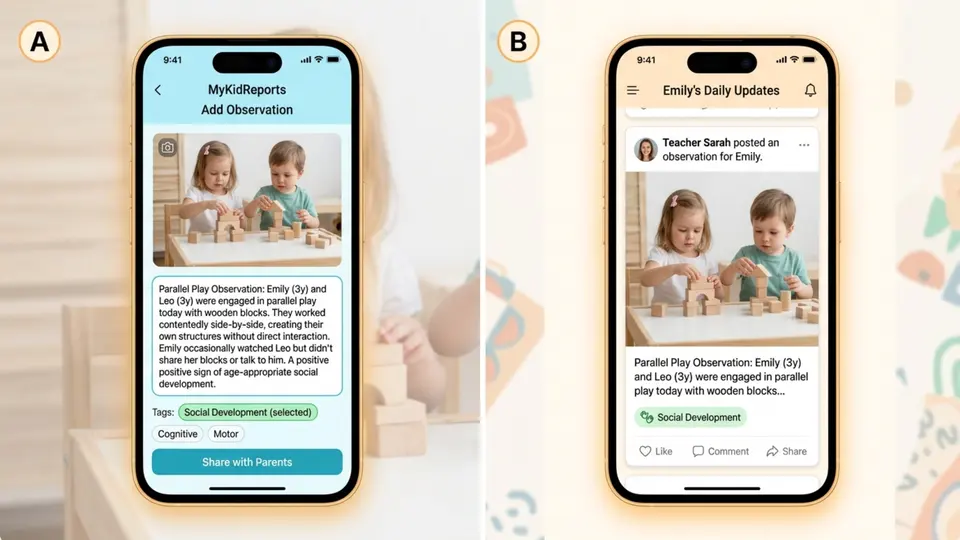
MyKidReports gives teachers a simple way to log developmental observations alongside daily reports, photos, and milestone tracking — and then automatically shares them with parents in the parent app.
A teacher in the 2-year-old room can:
- Snap a photo of Mia building blocks next to Jacob
- Tag it as a social development observation (parallel play)
- Add a one-line note: "Played near Jacob at the block area for 15 minutes today — first sustained parallel play this week."
- Hit send. The note goes to the family, gets saved to Mia's developmental record, and rolls into the monthly progress summary the director reviews.
For directors running a center-based program or a home-based daycare, the value is the pattern: when you can see across your whole roster that Sasha (age 3) is still mostly in solitary play while peers have moved to associative play, you can have an informed, early conversation with her family. That kind of early signal — caught from real classroom observation, not parent guesswork — is what builds a daycare's reputation for developmental excellence.
See it in action. Start a free MyKidReports account in 5 minutes. Track up to 5 children free forever — perfect for a single classroom pilot before rolling it out program-wide. |
FAQ — Parallel Play
How old is a child during parallel play?
Parallel play typically appears between ages 2 and 4, with the peak around 2 to 3 years old. Most children begin transitioning toward associative play between ages 3 and 4.
Is parallel play a sign of autism?
No. Parallel play is a normal stage of development for all toddlers. Children with autism may stay in solitary or parallel play longer than peers and may show less interest in peer awareness — but parallel play by itself is not a diagnostic sign. If you have concerns about a specific child, document observations and recommend the family discuss developmental screening with their pediatrician.
What's the difference between parallel and associative play?
In parallel play, children play side-by-side but don't interact. In associative play, they're now interacting — sharing materials, swapping toys, chatting about what they're doing — but they're still not coordinated around a shared goal. Associative play is the bridge between parallel and full cooperative play.
Should I encourage my toddler to play with other children?
Yes, but not by forcing direct interaction. The best way to encourage social play in a 2-year-old is to put them in proximity to peers, give them their own materials similar to what others have, and let parallel play happen naturally. Don't push them to share or "play together" before they're ready.
How can teachers support parallel play?
Three things: set up the environment so each child has their own materials, allow extended unstructured time near peers, and resist the urge to direct or push children into cooperative play. Be available but not directive.
When should parallel play start fading?
Most children start showing associative play behaviors between ages 3 and 4. By age 4, cooperative play should be emerging as the dominant mode. If a child age 4+ is still exclusively in parallel play, document the observation and consider whether developmental screening would help the family.
Closing thought
Parallel play looks like nothing is happening. Two toddlers side-by-side, each in their own world.
It's the opposite. It's one of the most cognitively rich moments of a toddler's day. They're learning what other children look like, sound like, do with the same materials, react like. They're loading the operating system for cooperation that will boot up in another year or two.
The teacher who walks in and worries about "why aren't they playing together?" is missing the point. The teacher who sees a quiet, focused, side-by-side moment and lets it run — that teacher is doing developmental gold.
Pass this guide along to your team. Print the activity list. Set up the room. And the next time you see two toddlers stacking cups in silence, eighteen inches apart — smile, like the fifteen-year director smiles.
Track every developmental moment with MyKidReports Photos, daily notes, milestone tracking, parent updates — all from one teacher app. |